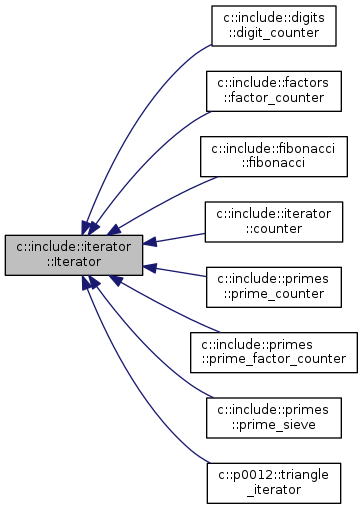
An implementation of Python-like iterators and generators in C.
More...
#include <iterator.h>
|
| bool | exhausted: 1 |
| | An indicator that the iterator has stopped. More...
|
| |
| bool | started: 1 |
| | An indicator that the iterator has started. More...
|
| |
| bool | phase: 1 |
| | An indicator that changes each time the iterator moves. More...
|
| |
|
(Note that these are not member functions.)
|
| #define | IteratorTail(return_type, struct_type) |
| | The base definition macro for all iterators in this project. More...
|
| |
| #define | IterationHead(it) |
| | The base macro for all iteration functions in this project. More...
|
| |
| #define | IteratorInitHead(advance, ...) {.iterator_function = &advance, AddDestructor(no_destructor), __VA_ARGS__} |
| | The base macro for all iterator initialization functions in this project. More...
|
| |
| #define | AddDestructor(func) ExtendInit(destructor, (void (*const)(void *)) &func) |
| | The extension macro for initializing Iterators with a destructor. More...
|
| |
| #define | ExtendInit(name, value) .name = value |
| | The extension macro for initializing more complicated Iterators. More...
|
| |
| #define | next(state) (*(state.iterator_function))(&state) |
| | The macro to advance generic iterators. More...
|
| |
| #define | next_p(state) (*(state->iterator_function))(state) |
| | The macro to advance generic iterator pointers. More...
|
| |
| #define | free_iterator(it) (*(it.destructor))(&it) |
| | The generic destructor for iterators. More...
|
| |
| #define | free_iterator_p(it) (*(it->destructor))(it) |
| | The generic destructor for iterator pointers. More...
|
| |
An implementation of Python-like iterators and generators in C.
- See also
- counter For an example implementation
| #define AddDestructor |
( |
|
func | ) |
ExtendInit(destructor, (void (*const)(void *)) &func) |
|
related |
The extension macro for initializing Iterators with a destructor.
- Parameters
-
| func | The destructor function of your iterator |
- Attention
- When adding a destructor to an Iterator subclass it MUST have the following signature:
void function_name(iterator_subclass *is)
Assignment example:
Direct return example:
| #define ExtendInit |
( |
|
name, |
|
|
|
value |
|
) |
| .name = value |
|
related |
The extension macro for initializing more complicated Iterators.
- Parameters
-
| name | The name you would like to assign to in the struct (do not include the struct name or initial .) |
| value | The value you would like to assign |
Assignment example:
Direct return example:
| #define free_iterator |
( |
|
it | ) |
(*(it.destructor))(&it) |
|
related |
The generic destructor for iterators.
- Parameters
-
| it | The iterator you wish to destruct |
- See also
- free_iterator_p For a version that deals with pointers
-
counter for an example implementation
- Note
- Any given subclass might not include a destructor if nothing needs cleaning. That does not mean you should not call this function, as that may change in the future, and on most compilers it typically adds very little overhead (order of 3 instructions).
| #define free_iterator_p |
( |
|
it | ) |
(*(it->destructor))(it) |
|
related |
The generic destructor for iterator pointers.
- Parameters
-
| it | A pointer to the iterator you wish to destruct |
- See also
- free_iterator For a version that deals with direct objects
-
counter for an example implementation
- Note
- Any given subclass might not include a destructor if nothing needs cleaning. That does not mean you should not call this function, as that may change in the future, and on most compilers it typically adds very little overhead (order of 3 instructions).
| #define IterationHead |
( |
|
it | ) |
|
|
related |
Value:it->started = 1; \
it->phase = !(it->phase)
The base macro for all iteration functions in this project.
- Parameters
-
| it | The pointer to the iterator you are advancing |
- See also
- counter for an example implementation
Example:
if (!ct->exhausted) {
const uintmax_t ret = ct->idx;
ct->idx += ct->step;
ct->exhausted = (ct->idx >= ct->stop);
return ret;
}
return -1;
}
The base macro for all iterator initialization functions in this project.
- Parameters
-
| advance | The function this iterator uses to advance |
| ... | Additional things to initialize wrapped in ExtendInit() |
- Returns
- A compound literal that initializes the Iterator-defined portions of your subclass
- See also
- counter for an example implementation
- Note
- All values not directly related to the Iterator class will be initialized according to the C99 rules for compound literals. This means:
- Numeric types are initialized to
0
- Pointer types are initialized to
NULL
- Composite types are initialized recursively by these rules
- Attention
- The iterator function you give it MUST take in ONLY a pointer to the declared struct
-
Because the pointer to the iteration function is constant, any nested Iterators must be initialized in the original assigning expression, and Iterators cannot be reassigned to entierely. It is often recommended to provide a "reset" function as an alternative to the standard constructor if you want these objects to be reused.
Example:
ct.step = 1;
ct.stop = 100;
return ct;
}
| #define IteratorTail |
( |
|
return_type, |
|
|
|
struct_type |
|
) |
| |
|
related |
Value:return_type (*const iterator_function)(struct_type *it); \
void (*const destructor)(void *it); \
The base definition macro for all iterators in this project.
- Parameters
-
| return_type | The type that your iterator will yield |
| struct_type | The type that your iterator state is stored in |
- See also
- counter for an example implementation
- Attention
- When you are declaring an Iterator struct, you MUST DECLARE IT FIRST in order to feed it to this macro
Example:
uintmax_t idx;
uintmax_t stop;
intmax_t step;
bool example_bit : 1;
};
| #define next |
( |
|
state | ) |
(*(state.iterator_function))(&state) |
|
related |
The macro to advance generic iterators.
- Parameters
-
| state | The iterator you wish to advance |
- Returns
- The next item generated by the given iterator
- See also
- next_p For a version that deals with pointers
-
counter for an example implementation
| #define next_p |
( |
|
state | ) |
(*(state->iterator_function))(state) |
|
related |
The macro to advance generic iterator pointers.
- Parameters
-
| state | The pointer to the iterator you wish to advance |
- Returns
- The next item generated by the given iterator
- See also
- next For a version that deals with direct objects
-
counter for an example implementation
| bool c::include::iterator::Iterator::exhausted |
An indicator that the iterator has stopped.
| bool c::include::iterator::Iterator::phase |
An indicator that changes each time the iterator moves.
| bool c::include::iterator::Iterator::started |
An indicator that the iterator has started.
The documentation for this struct was generated from the following file:
 1.8.11

